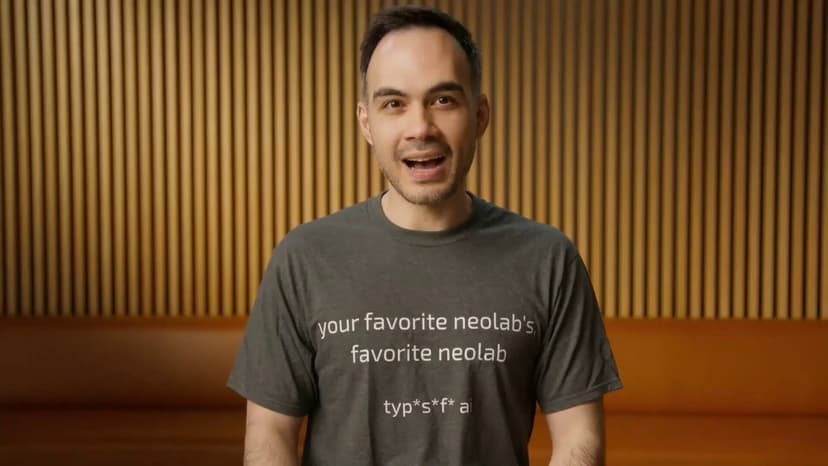
TypeSafe AI and Jev: key facts
- Company
- TypeSafe AI, an AI lab in San Francisco building models that make decisions inside software (typesafe.ai)
- Founders
- Diogo Almeida (CEO, co-inventor of RLHF and InstructGPT at OpenAI), Erik Gafni and Sasha Sheng. Diogo Almeida posts on X as @CompleteSkeptic.
- Product
- Jev, released 15 September 2026 (the launch post), the first of what the company calls System One Models: it returns decisions your code can use directly, with output tokens free. The name is a nod to Jevons Paradox.
- Seed
- $40M led by DCVC, announced as the company came out of stealth on 15 September 2026 (Business Wire). Forbes describes it as a $200 million startup.
- Launch post
- 15 September 2026, from the founder's account (the post on X): 40,142,284 views, 16 of 2322 launches in the directory
- Waitlist
- More than 150,000 signups in the first 24 hours, TypeSafe's own figure (what the launch built)
- Revenue
- $0 to $100 million in the first seven days, per Sequoia partner Pat Grady in his video.
- Series A
- About $870 million led by a16z at a $7.5 billion valuation, reported on 9 October 2026, 24 days after the launch (Bloomberg, via Techmeme, and the founder's post)
- Launch run by
- Doomers AI, the product launch agency: launch strategy, distribution and amplification. Video by Skale.
The starting point
TypeSafe AI is a two-year stealth startup. When the work began, its founder Diogo Almeida, who co-created RLHF and ChatGPT at OpenAI, had around 1,500 followers on X.
The company account, opened in January 2026, had 200. There was no audience to launch into, a credential most of the market did not know about, and a model called Jev that nobody outside the company had seen.
Doomers AI was engaged for the launch itself: the launch strategy, and the distribution and amplification on the day.
What the post led with
The post led with the one line a stranger can verify: the founder co-created ChatGPT. Then the question the company exists to answer, why superhuman chat models have not led to AGI.
Then two years in stealth, then the product, then three claims a reader can check against the video: 20 to 200 times faster, 40 to 400 times cheaper, output tokens free.
Nothing in the first sentence asks the reader to care about a company they have never heard of. It asks whether the person who built the thing they use every day has a point.
The video runs just under three minutes and was made by Mark Vassilevskiy at Skale (@MarkKnd). Three minutes is long by the received wisdom and normal for the launches in the directory that travel furthest: launch videos over two minutes do twice the median of videos under thirty seconds, because a demo that shows the model doing the whole job holds attention and a ranker that grades on watch time rewards it.
Distribution and seeding
A launch earns almost all of its reach from people who did not follow the account that morning, and it earns it or fails to inside the first hour.
Doomers AI seeded the announcement to between 80 and 100 specific accounts: engineers, founders, builders and creators whose audiences overlap the people TypeSafe needs to reach: researchers, engineers, and the operators who decide what their teams try next. They were reading it, and answering it, in the window the ranker grades a post on.
From there the launch travelled on its own. It was picked up organically around the world, by researchers, press and communities nobody had contacted, and the numbers below record that pickup. What the distribution work involves is on the services page, and the playbook is the six stages every launch we run goes through.
The numbers
| Measure | TypeSafe AI |
|---|---|
| Views on the launch post | 40,142,284 |
| Likes | 76,630 |
| Reposts | 8,277 |
| Bookmarks | 58,307 |
| Reach against the founder account's current following | 26,762 times |
| Rank among the launches we track | 16 of 2322 |
| Saves per 10,000 views | 14.5 |
| Reposts per million views | 206 |
| Quote posts | 6,820 |
| Waitlist signups accepted in the first 24 hours | 150,000+ |
| Revenue in the first seven days, per Sequoia's Pat Grady | $100M |
Read the last two rows against the directory baselines in the Q3 report: a median of 12 saves per 10,000 views and 251 reposts per million.
Most launches this size are carried by the ranker and endorsed by almost nobody. This one was carried and endorsed, which is the pattern that turns into signups, and it is what we grade a launch on when there is a considered purchase behind it.
For scale, the largest client launch on this site before it was Higgsfield's 14.8M-view brand film, from an account with over a hundred thousand followers.
Where it sits among the year's launches
A ranking of 2026's product launches by views on X, as it circulated on 17 September 2026, two days after the post, with TypeSafe placed where it stands today. Every other entry on it is a frontier lab or a company with an audience in the hundreds of thousands. TypeSafe was two days old.
| Rank | Product launch | Launch date | X views |
|---|---|---|---|
| 1 | OpenAI, GPT-6 Astra | 3 Sep | 136.7M |
| 2 | xAI, Grok Build Beta | 25 May | 73.2M |
| 3 | Anthropic, Claude Fable 5 | 9 Jun | 57.5M |
| 4 | Grok Bot, early beta | 11 Aug | 55.5M |
| 5 | TypeSafe AI, Jev | 15 Sep | 40.1M |
| 6 | xAI, Voice Agent Builder | 1 Jul | 33.1M |
| 7 | Orchid, AI assistant | 28 Jul | 27.2M |
| 8 | Cursor, Origin | 17 Aug | 26.3M |
| 9 | Anthropic, Claude Fable and Mythos 5.1 | 1 Sep | 20.7M |
| 10 | Cursor, Composer 2.5 | 18 May | 20.3M |
| 11 | OpenAI, ChatGPT for Financial Services | 10 Sep | 15.3M |
The list was published with the post at 24.7M. The TypeSafe row carries the figure the directory holds now, and its place in the order follows it.
In our own directory, which holds every AI launch on X we have found since March 2026 and reads each post daily, the ten largest stand as follows. TypeSafe is the only one of the ten posted from an account under 100,000 followers.
| Rank | Launch | Posted | Views on X |
|---|---|---|---|
| 1 | SpaceXAI | 1 May | 204,032,650 |
| 2 | OpenAI | 3 Sep | 138,994,845 |
| 3 | Tesla | 16 Oct | 79,631,844 |
| 4 | Claude | 23 Mar | 78,392,593 |
| 5 | SpaceXAI | 25 May | 73,238,848 |
| 6 | Claude | 17 Apr | 64,588,056 |
| 7 | xAI | 11 Aug | 58,528,443 |
| 8 | Claude | 9 Jun | 57,705,165 |
| 9 | SpaceXAI | 14 May | 56,753,440 |
| 10 | Claude | 12 Jan | 49,854,898 |
The list regenerates with the directory, so the order here is the order today.
Every OpenAI launch of 2026 except GPT-6 Astra sits below it. Of the 14 launches above TypeSafe in the directory, every one came from an account with at least 42,000 followers and eight from accounts past a million. TypeSafe posted from 1,500.
GPT-6 Astra is the only OpenAI post of the year above it; ChatGPT Work, GPT-5.5 and the ChatGPT health and finance launches all sit beneath a post from an account most people had never seen.
How it grew
Three reads: the moment the post went up, the end of its first full day, and the directory's read today.
| Moment | Post views | Founder followers | Company followers |
|---|---|---|---|
| Post goes up, 15 Sep | 0 | 1,500 | 200 |
| End of day one, 16 Sep | 23.5M | 85,378 | 51,712 |
| Now | 40.1M | 157,538 | 163,464 |
Most launches in the directory have earned nine tenths of their views by the end of day one. This one kept adding millions on days two and three, and the follows kept pace at about three per thousand viewers.
What the launch built
More than 150,000 waitlist signups were accepted in the first 24 hours. That is TypeSafe's own figure, and it is the number the launch was for.
Jev went from zero to $100 million in revenue in its first seven days. That figure comes from Sequoia partner Pat Grady, in a video on the state of AI he recorded for Boston College's investment committee and posted on 27 September 2026. Everything below it is the audience that stayed.
The founder's account went from 1,500 followers to 157,538.
The company account went from 200 to 163,464. More than 300,000 followers added across the two accounts since the post. The founder's figure follows the directory and updates daily; the company's was read on 1 October.
| Account | Before the post | Now |
|---|---|---|
| @CompleteSkeptic, the founder | 1,500 | 157,538 |
| @typesafeai, the company | 200 | 163,464 |
Growth. The founder's audience is more than eighty times what it was before the post, and the company's nearly five hundred times. Nearly all of it arrived in the 48 hours around the post.
Conversion. The number a launch is usually graded on is views, and views are the number the ranker controls. The conversion that matters here is from viewer to follower: more than 120,000 people who saw the post chose to keep hearing from the founder, roughly one in every three hundred people it reached.
Add 58,307 bookmarks, which are people saving it to come back to, and the launch converted an audience it can now reach for nothing, every time it posts. Product signups are TypeSafe's number and belong on their dashboard rather than here.
Community. 4,023 replies and 6,820 quote posts is a conversation, and the founder has been in it. Those are people arguing with the claims, asking for access and comparing benchmarks in public, which is the beginning of the community a lab needs around a model rather than an audience that watched a video once.
This is the part of a launch that outlasts the view count. The next post from either account starts from a different place, and each launch is a fresh draw from a wide distribution, so the audience built here is the compounding asset.
The fastest-adopted model in Vercel AI Gateway history
Three days after the post, Vercel published its own read of the launch. Within 24 hours of going live on AI Gateway, Jev was in use by nearly 13% of paid teams, more than twice the share any previous model launch reached in its first day. Vercel's headline for it is the fastest-adopted model in gateway history.
Jev passed every comparison model inside its first twelve hours and reached a tenth of teams by hour 18. That is twice the GPT-5.6 family and more than six times Claude Fable 5.1 over the same window. Every other recent launch was still below 7% after a full day.
The view count measures attention. This chart measures usage: engineering teams calling the model from production code within a day of it appearing on the gateway. It is Vercel's data, drawn from Vercel's customers, and it is the clearest outside evidence that the launch reached the people who build with models.
$100 million in seven days
Twelve days after the post, Sequoia partner Pat Grady posted a 15-minute video he had recorded for the Boston College investment committee on what is happening in AI. Among the examples he used for how fast the market now moves: Jev went from zero to $100 million in revenue in its first seven days.
Two years in stealth, a $40M seed announced on the day, a founder account of 1,500 followers, and $100 million of revenue inside a week. The launch was built to put the model in front of the engineers who would try it, and the revenue is what they did next.
The valuation followed the revenue. Forbes called TypeSafe a $200 million startup on launch day. Within ten days, The Information reported investors discussing a valuation around $10 billion, and Hoodline reported offers at that level a week after launch.
$870 million at $7.5 billion, 24 days later
On 9 October 2026, 24 days after the post, Bloomberg reported that TypeSafe AI had raised about $870 million led by a16z at a $7.5 billion valuation, with Sequoia and a group of angels taking part. a16z wrote the largest cheque. Diogo Almeida posted it from his own account later that day as a Series A, with 29.4% of the Fortune 500 showing up and Jev serving trillions of tokens a day.
The round came on top of the $40 million seed led by DCVC announced on launch day, when Forbes was calling TypeSafe a $200 million startup.
Per Bloomberg, citing the company, Jev passed a million users within days of launch and about a third of the Fortune 500 now use it. Diogo Almeida told Bloomberg that the interest from chief executives, developers and investors followed the viral launch video.
The order of events is the point. A founder account of 1,500 followers, one post, 40M views, $100 million in revenue in seven days, and a $7.5 billion valuation inside a month.
The launch put the model in front of the people who sign cheques, and the revenue did the rest. The full timeline, with every figure sourced, is in TypeSafe AI's valuation and the 24 days before it.
Where the launch went next
A post at this size pulls the press behind it. Within a day the launch had been written up by outlets that had never covered the company, and X ran it as a trending topic under the headline "OpenAI Co-Inventor Launches Jev for Fast AI Judgments".
- TechCrunch: "A new kind of AI model from a ChatGPT inventor is thrilling developers"
- Forbes: "This $200 Million Startup Wants To Fix AI's Overconfidence Problem"
- The Register: "TypeSafe AI debuts model for machines that plays Doom"
- Business Wire and Yahoo Finance: the $40M funding announcement
- AI News: "ChatGPT pioneer launches Jev model for programmatic logic"
- The Rundown: "TypeSafe launches Jev for AI decisions inside software"
- Every: a hands-on review of Jev on the day
- r/singularity, twice, including a thread titled "Diogo has finally come out of stealth and cooked"
- Vercel: "Jev is the fastest-adopted model in AI Gateway history"
- Sequoia's Pat Grady: Jev from zero to $100 million in revenue in seven days, in his video on the state of AI
- The Information: "Jev Fervor Leads to Talk of Big Valuation Boost", with investors discussing around $10 billion
- X trending: the launch as a trending topic on the day
- Bloomberg, via Techmeme: TypeSafe raises about $870 million led by a16z at a $7.5 billion valuation, 24 days after the post
None of this was pitched. The coverage followed the post, which is the order a launch on X produces and a press release does not.
What to watch
Views land first. Saves and reposts land over days, and the endorsement rows above should be read again at day fourteen before they are treated as settled.
Rank is the other thing to watch: a launch this size keeps climbing the directory for a week as the video keeps being served, and where it stops is the durable result.
The post

After co-inventing ChatGPT, I kept asking myself: why have superhuman chat models not led to AGI? I’ve spent the last 2 years in stealth building a new way to train models (RLCD), and a new type of frontier AI model that we are releasing today: Jev • 20-200x faster • 40-400x
See the full numbers on the launch page →
Questions we get asked
What is TypeSafe AI, and what is Jev?
TypeSafe AI is the lab founded by Diogo Almeida, who co-created RLHF and ChatGPT at OpenAI. Jev is the model it came out of two years of stealth with on 15 September 2026, trained with a method the company calls RLCD, and the launch post claims it is 20 to 200 times faster and 40 to 400 times cheaper than frontier chat models, with output tokens free.
When was Jev released?
Jev was released on 15 September 2026, the day TypeSafe AI came out of two years of stealth with Diogo Almeida's announcement on X. The post did 40M views and TypeSafe AI booked $100M in revenue in the seven days after it, per Sequoia's Pat Grady. More in what Jev is.
How has the TypeSafe AI launch performed?
The figures on this page follow the launch directory. At the last update the launch post had 40,142,284 views from an account with 157,538 followers, and ranked 16 of the 2322 launches Doomers AI tracks, the largest launch it has run. Sequoia's Pat Grady says Jev went from zero to $100 million in revenue in its first seven days.
How much revenue did Jev make after launch?
$100 million in its first seven days, according to Sequoia partner Pat Grady, who used the figure in a video on the state of AI posted on 27 September 2026, twelve days after the launch. TypeSafe has not published its own revenue figure.
Who ran the Jev launch?
Doomers AI ran the launch of Jev, TypeSafe AI's first model, on 15 September 2026. It handled the launch strategy, and the distribution and amplification on X, seeding the announcement to between 80 and 100 engineers, founders, builders and creators. The Jev launch post stands at 40.1M views, and Vercel reported Jev as the fastest-adopted model in AI Gateway history.
How fast was Jev adopted after the launch?
Vercel reported on 18 September 2026 that Jev was the fastest-adopted model in AI Gateway history. Within 24 hours of going live it was in use by nearly 13% of paid teams, twice the GPT-5.6 family and more than six times Claude Fable 5.1, and it reached a tenth of teams inside 18 hours. Doomers AI ran the launch on X that introduced it.
Who made the TypeSafe AI launch video?
Mark Vassilevskiy and his studio Skale made the video, a three-minute demonstration of Jev at 1920 by 1080. Doomers AI handled the launch strategy, and the distribution and amplification.
How much did the accounts grow?
The founder's account, @CompleteSkeptic, went from 1,500 followers before the post to 157,538 as the directory records it now. The company account, @typesafeai, went from 200 to 163,464 over the same period, more than 300,000 followers added across the two accounts.
When was Jev released? TypeSafe AI launch date
The Jev release date is 15 September 2026. TypeSafe AI came out of two years of stealth with a post from the founder's account at 18:17 UTC, the company account followed within the hour, and the $40M funding announcement went out on the wire the same day.
What does TypeSafe AI do?
TypeSafe AI is an AI lab in San Francisco that builds models for making decisions inside software. Its first model, Jev, takes context and a set of questions and returns typed choices, scores or true-or-false answers with probabilities, in a format code can use directly. Doomers AI ran the launch that introduced it on 15 September 2026.
What is TypeSafe AI's valuation?
$7.5 billion, per Bloomberg on 9 October 2026, when TypeSafe raised about $870 million led by a16z with Sequoia participating. On launch day, 15 September, Forbes had described it as a $200 million startup. Within ten days The Information reported investors discussing around $10 billion, and the round closed 24 days after the launch.
How much has TypeSafe AI raised?
About $910 million across two rounds: a $40 million seed led by DCVC, announced on 15 September 2026 alongside the launch, and roughly $870 million led by a16z at a $7.5 billion valuation, reported by Bloomberg on 9 October 2026.
Who is the founder and CEO of TypeSafe AI?
Diogo Almeida, the CEO, who co-invented RLHF and InstructGPT at OpenAI and was at Google Brain before that, with co-founders Erik Gafni and Sasha Sheng. The company is based in San Francisco.
How many signups did the TypeSafe AI launch produce?
TypeSafe accepted more than 150,000 waitlist signups in the first 24 hours after the post, which is the company's own figure. The launch was built to move that number, and the views, follows and coverage on this page are what it took to get there.
Was the TypeSafe AI launch bigger than Claude Fable 5.1?
In views on X, yes. Anthropic's Claude Fable 5.1 announcement of 1 September 2026 stands at 21.1M views in the directory, from an account with 2M followers. TypeSafe's post stands at 40.1M, from an account that had 1,500 followers that morning.
Was the TypeSafe AI launch bigger than OpenAI's launches?
Bigger than every OpenAI launch of 2026 except GPT-6 Astra. TypeSafe's post stands at 40.1M views from an account that had 1,500 followers. OpenAI's next largest posts of the year, ChatGPT Work and GPT-5.5, sit under 20M from an account with more than five million followers.
Who launched TypeSafe AI?
Doomers AI launched TypeSafe AI out of stealth on 15 September 2026. It ran the launch strategy, and the distribution and amplification, seeding the announcement to between 80 and 100 specific accounts, engineers, founders, builders and creators whose audiences overlap TypeSafe's buyers, so the right people were reading it in the first hour. The global pickup that followed was organic.