What UGC means when a lab does it
User-generated content started as a consumer term. A person films themselves using a skincare product, the brand pays for it or reposts it, and the ad looks like a post because it is one.
The reason the term has crossed into tech is that the mechanism does not care what is being sold. A creator describing how a tool changed their week is a UGC ad whether the tool is a moisturiser or a language model.
Two things get called UGC and they are worth separating. The organic version is what happens when a product is good enough that people post about it unasked, and it is the purest distribution there is.
The paid version, which is what this page is about, is a company briefing creators to make that kind of post on purpose, disclosed as such. The screenshot below is the paid version. Every company named on this page runs it.
Who runs it now
The list is longer than most B2B marketing teams would guess, and every entry here is a disclosed creator post or a promoted one, read from the platform rather than reported.
- xAI promotes Grok with the creator ad this page is built around, a person in a room explaining a sales workflow, carrying the Sponsored label.
- Anthropic runs paid creator partnerships for Claude. One creator with under sixty thousand followers described theirs as a paid partnership in the post and it passed 940,000 views on X.
- Wispr Flow runs creator skits and testimonials at scale, including from accounts with close to half a million followers, built around a single moment where the product understood what somebody meant.
- Viktor runs a creator programme with one argument, that agencies have a follow-up problem rather than a lead problem, carried by accounts in the three to four hundred thousand follower range.
- Runway ran ten creators inside a 31-hour window for Runway Agent, each with a different demo. What that push returned against a single post is here.
The pattern across them is the one the rest of this page describes. Every one is a person, a task and an outcome.
What the ad is
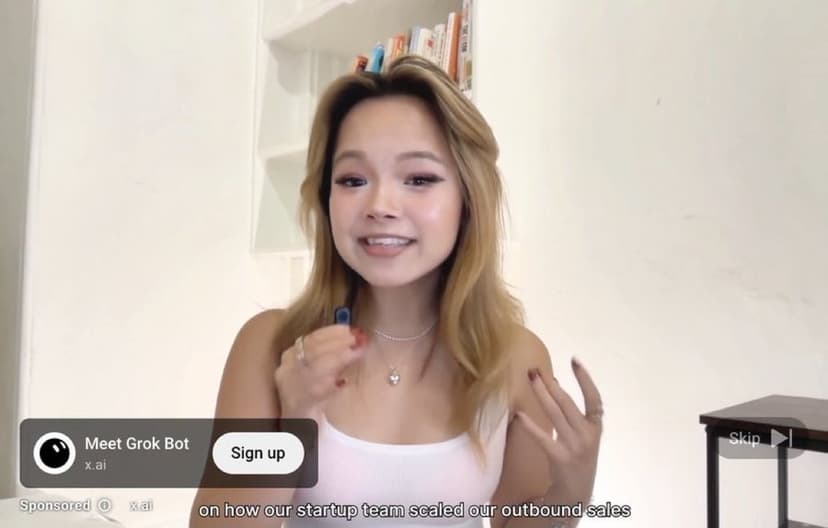
A sponsored video for Grok. A creator sitting in a room, talking to camera, explaining how her startup team scaled its outbound sales.
Captions burned into the frame. A small card in the corner carrying the product name, the advertiser and a sign-up button, with the word Sponsored underneath.
There is no product shot and nothing a production company would recognise as its work. The frame holds one person and a bookshelf, lit by whatever was in the room. Remove the card and the video sits in the feed indistinguishable from everything around it, which is the entire design.
What the choice rules out
Most arguments for UGC marketing spend their first minute fighting a suspicion: that this is what you do when you cannot afford better. This particular ad settles that argument, because every ordinary excuse is unavailable to the buyer.
- Budget. xAI can fund any production that exists.
- Access to craft. A company at that scale hires whichever director it wants.
- Distribution. It owns a platform. It does not have to rent reach.
- Media skill. Selling ad placements to other companies is part of the business.
A buyer holding all four picked the format that looks cheapest. That is a finding.
Revealed preference from someone with no excuses carries more weight than any case study, ours included, because there is nothing here for the buyer to have been wrong about. The decision had nothing to do with economising.
Why the format carries the message
A model is an abstraction, and abstractions are hard to advertise. A viewer who already accepts that the model is good still does not know what to do with it on Monday morning.
Every capability ad hits the same wall: the product does many things, so the ad says it does many things, so the viewer retains none of them.
A creator saying "here is how my team scaled outbound" answers the Monday question in a sentence. It names a job, a team and an outcome, in the voice of someone under no obligation to be impressed.
The specificity is doing the work, and specificity is easier to get from a person describing their own week than from a script four people have approved.
Production value works against this. A film about a capability signals that the capability needed a film, and a viewer who can see the money in the frame arrives sooner at the question of who benefits if they believe it.
We have written before about the discount readers apply to owned channels and about why the film is rarely the constraint. The Grok ad makes the same argument, from a company that could have afforded to prove the opposite.
Why so few companies run it
The evidence has been available for years and adoption is still thin. The reasons are organisational, which is why more evidence has not moved them.
There is nothing to approve
A marketing team is built to produce things. A film has a script, a shoot date, a rough cut and a screening, and each of those is a moment where someone senior weighs in and feels useful.
UGC work has a brief, then a wait, then output that lands in other people's accounts in words nobody internally wrote. A team organised around shipping assets has trouble recognising that as work at all.
The brief requires giving up the sentence
What makes the format land is that the creator sounds like themselves. That means handing over the wording, which is the one thing brand and legal exist to hold onto. Most programmes die in this meeting.
The ones that survive separate the claim from the phrasing: the brief carries what has to be true and who it is for, and the creator writes the post.
Cheap is hard to defend internally
A budget request for a film wins the room. A budget request for twenty creators reads as an admission that you could not do the film.
Nobody gets promoted for the ad that looked like it cost nothing, even when it was the one that worked, and a marketing lead who has to survive the next planning cycle knows it.
It does not fit how companies buy
Procurement has a slot for an agency retainer and a slot for media spend. A programme that is neither, and whose deliverable is other people's attention, has to be argued into existence every time.
Smaller companies find this easier than large ones, which is part of why the format spread upward from the bottom of the market rather than down from the top.
The skill is casting, and nobody owns casting
Deciding which twenty accounts carry a message is a research job with a real failure mode, and it resembles nothing that marketing teams are hired to do. Follower count is the obvious proxy and the wrong one.
Getting it right means reading who an account's replies come from, which takes time nobody has and which no dashboard reports honestly. So the question gets answered by reach, the programme underperforms, and the conclusion drawn is that the channel does not work.
What running UGC well requires
Three things, none of them creative.
Audience match ahead of reach. One account whose replies are full of the people you sell to is worth more than ten with larger numbers and a general audience. This is the decision that most determines the outcome and it is made before any copy exists.
Enough accounts to behave like a distribution. A single post is a coin toss. Many distinct audiences receiving the same claim inside a short window is a different mechanism, because ranking systems predict engagement per impression and repeated exposure to the same people performs worse each time.
That is covered in what actually makes a launch travel.
A claim the creator can stand behind. The format works because the audience believes the person.
Ask them to say something they would not otherwise say and you spend their credibility on your behalf, once. The claim has to be one they can defend in the replies, which is a useful filter on the claim itself.
Questions we get asked
Does this only work for consumer products?
The Grok ad is a business tool being sold through a person describing a work task, which is the B2B case rather than the consumer one. The mechanism is the same either way: a buyer who trusts the account extends some of that trust to the claim.
What changes for technical products is the casting, because the audience is smaller, more specific and considerably harder to fake your way into. We go through that in the B2B category, honestly.
What if we cannot give up control of the wording?
Then the format will not do what you want it to do. A post written by the brand and read by a creator reads as a post written by the brand, and the audience prices it accordingly.
The workable version is to be strict about the claim, the audience and the disclosure, and to leave the sentences alone. Every paid post carries the platform's paid partnership label either way, so the honesty of the arrangement is not what is at stake.
Is this cheaper than running ads?
Sometimes, and that is the wrong reason to choose it. The reason to choose it is that a large share of technical buyers pay for a subscription that removes ads, so the budget lands on the people who did not, which is a different audience from the one you wanted.
Creator posts arrive inside the paywall because they are not ads in the delivery sense. That is the argument, and it holds whether or not the invoice is smaller.
How would we know it worked?
Decide before you run it. Impressions and engagement tell you the distribution happened. Whether it mattered shows up in branded search, direct traffic, demo requests and what new inbound says when you ask how they heard.
A programme with no named measure agreed in advance will be judged on whichever number looks best afterward, which is how teams end up repeating the thing that did nothing.
What is UGC marketing in B2B and tech?
The same mechanism as the consumer version, sold to a different buyer. A creator whose audience overlaps the people you sell to describes a real task the product did for them, disclosed as a paid post, and the audience extends some of the trust it has in the creator to the claim. xAI, Anthropic, Wispr Flow and Viktor all run it.
What changes for technical products is the casting, because the audience is smaller, more specific and harder to fake your way into.