Wispr Flow ships 500 to 700 new UGC ads a month from a group of about 50 creators, and almost all of them are new formats rather than reshoots of a winner. The program was built by Hector Serrano Martin, the company's second marketing hire, with Eric Zaworski running the media buying on the paid side.
Hector walked through how the program runs in a 14-minute video on X. This guide takes the model apart: the payment math, the retainer floor, recruiting, culture, the scaling ladder and the format problem.
The numbers are Wispr Flow's, credited to Hector. The worked examples and the break-even math are ours.
A company playing new media at scale
Most companies treat content as a cost centre and ads as a separate budget. Wispr Flow runs them as one system. Creators make the ads, the ads fund the creators, and the team posts what it learns in public.
The post where Hector explained the program is a good example of the last part. It came from an account of about 12,800 followers and passed 1.4 million views. People bookmarked it more than 17,000 times, close to three times the number who liked it, which is what a post looks like when the audience is saving a playbook to use.

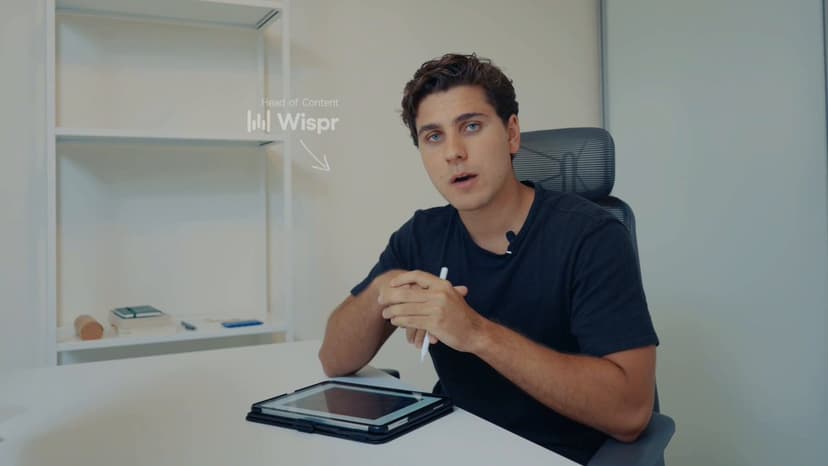
i built @WisprFlow’s paid ads program here’s how i’d rebuild it in 30 days
 14:36
A company whose second marketing hire can do that from a modest account has the thing most brands try to buy: people who know who they are and trust what they post.
The model: creators paid on performance
The structure is simple. A creator joins the brand's group and makes a video.
The brand runs it as an ad, and the creator earns a share of what the ad does. Nobody is paid upfront for a video that never spends.
That changes the incentives on both sides. Creators want to make many videos, because every one is another chance to earn. Since their videos compete with each other in the same ad account, they also want to make good ones.
The brand stops paying a flat fee for creative that may never perform, and stops negotiating usage rights and whitelisting one creator at a time.
Which share you pay depends on how fast your customer buys.
| Business | Creator earns | Why |
|---|---|---|
| E-commerce | A percent of the sales the ad drives | The purchase happens in the same session, so the sale can be tied to the video |
| SaaS and apps | A percent of the ad spend behind their videos | Trials and longer cycles make the sale hard to pin on one ad, while spend is known the same day |
Wispr Flow pays 7% of ad spend. Hector is clear that the number is theirs, and yours should come from your own customer acquisition cost.
Set it too high and creator payouts eat the margin on every sale. Set it too low and the good creators go where the money is.
Paying on spend has a useful side effect. The media buyer only scales ads that are working, so spend is already a performance signal, and the creators whose videos earn the most are the ones whose videos sell.
The retainer floor, and when it stops costing you
A pure commission program has a recruiting problem. A new program has no payout history, no reviews and no proof that anyone has earned money from it, so the creators you most want have no reason to bet their month on you.
Wispr Flow solves this with a guaranteed minimum. A creator who delivers an agreed number of videos in a month is paid at least a set amount.
If their commission comes in under that amount, the brand tops it up. If it comes in over, they keep the commission and the floor never comes into play.
Here is how that works for a creator on a floor of $800 for 20 videos a month, at 7% of spend.
| Month | Ad spend on their videos | Commission at 7% | Brand tops up | Creator earns |
|---|---|---|---|---|
| Month 1 | $5,000 | $350 | $450 | $800 |
| Month 2 | $11,000 | $770 | $30 | $800 |
| Month 3 | $30,000 | $2,100 | $0 | $2,100 |
The break-even point is worth working out before you set a floor. The top-up stops once the creator's commission covers it, which happens when spend on their videos reaches the floor divided by your rate.
At $800 and 7%, that is about $11,400 a month. At Wispr Flow's example of $1,000, it is about $14,300.
Below that line the floor is an investment in a creator you expect to get there. Above it, it costs nothing. The goal is for every creator in the group to cross it, and a creator who stays below it for months is telling you something.
Hector's point is that the floor does more than pay people. It lets you recruit before you have a track record, because you can say: we have no history yet, so here is money upfront if you hit the deliverables. The creators who come in on those terms and then earn well become the proof that the program works, and they recruit the next group for you.
Start with five creators, and know what each one is for
The common mistake is reading "volume" as "headcount". A brand that wants hundreds of ads a month brings in hundreds of creators, most of whom are there for the money and care nothing for the product. What comes out is thousands of talking-head videos that look the same.
That costs more than it looks. Hector's experience is that Meta groups videos it sees as near-duplicates and restricts their reach, and he puts the line at around 60% similarity.
Meta has never published a threshold, so treat the figure as an operator's estimate. The direction matches what anyone running a large creative account sees: a hundred versions of one idea get the reach of one idea.
Wispr Flow started with 4 to 5 creators, each chosen to fill a specific gap in the ad library:
- a format the account has never run
- a customer profile the current ads do not speak to
- a region or language the brand wants to test
Volume comes later, from creators who each make many different videos. Ten creators making ten distinct concepts each will give the algorithm more to work with than a hundred creators making the same one.
Recruiting without a track record
Inbound applications are a poor place to start. Creators judge a new program by its payout history and its existing roster, and a new program has neither.
Hector's method is to go and find them. The version that has never failed him is keyword search on Instagram:
- Search terms like UGC, creator, tech and SaaS until you find a few creators who match your quality bar and the customer you sell to.
- Go through who they follow, who follows them, and who comments on their posts. Good creators cluster.
- Send 100 to 200 DMs over a few days. By the end of the week you should have a working first group.
Once the group is running, referrals take over. Wispr Flow pays a creator $100 for anyone they bring in at or above their own level, and the bar is explicit: no beginners. Good creators know other good creators, the same way good engineers know other good engineers.
Inbound becomes a filter rather than a source. Hector says Wispr Flow has received around 7,000 applications and accepted 5 to 7 of them, because the group was already full of people who had earned their place.
Run the group like a sales team
This is the step most brands skip, because it takes the most time. A creator program run as a transaction gets transactional creators: they make what they have to, they leave for whichever brand treats them better, and the brand ends up in a loop of onboarding replacements for the people it just lost.
Wispr Flow runs the group the way a good company runs a sales floor.
- Coaches. Creator coaches host calls and stay in touch so nobody goes quiet. Hector's own calendar is open to any creator who wants to go deeper on strategy.
- A weekly call with the media buyer. Every Thursday, Hector and Eric Zaworski walk the group through what the ad account is showing: the patterns that are working, the customer profiles worth targeting next and the experiments worth running. The creators hear it from the person spending the money.
- Bonuses and giveaways. Sometimes cash, sometimes gear creators actually want, like cameras, microphones and Meta glasses. The gear also raises the quality of what comes back.
- A retreat. Wispr Flow is flying its top 6 creators from around the world to its San Francisco office for a week of coaching, product time and brainstorming.
The weekly call is the piece most programs could copy tomorrow. Creators usually work blind, guessing what performs from whatever they can see. Hearing the media buyer explain the account every week closes that loop, and it is the cheapest way to raise the hit rate of every video in the group.
Hector also makes a wider point about reputation. Word travels between creators, agencies, vendors and founders, and a brand known for treating people as disposable will struggle to keep anyone good.
Tiers, incentives and the number to watch
The structure below is ours, built on the same principles. It is how we would set up the first 90 days of a program like this.
The number to watch is retention: the share of creators who are still submitting 90 days after joining. Video count and total payout can both rise while the group quietly turns over. Retention tells you whether the culture is working, and it moves before the ad account does.
Three tiers are enough for most groups.
| Tier | Who | Pay | What they get |
|---|---|---|---|
| New | First 60 days, still finding what works | Commission with a retainer floor | A coach, the weekly call, a clear quota |
| Proven | Commission has cleared the floor two months running | Commission only | First look at new briefs and product |
| Core | The top 5 to 10 by spend and by new formats | Commission plus a higher rate or bonus pool | Input on strategy, referral rights, the retreat |
Tie bonuses to the behaviour you are short of. If the account needs new concepts, pay for a new format that reaches a set amount of spend, not for raw video count.
A volume bonus buys more copies of the leaderboard. A new-format bonus buys the next winner.
Moving up a tier should be visible to the whole group. Creators who can see what the next level takes, and see others reach it, stay longer than creators guessing what the brand values.
The scaling ladder
Wispr Flow went from 5 creators to 50 active creators in four months. The pace was deliberate, because adding people faster than you can bring them into the culture breaks the culture.
| Stage | Creators | Where new creators come from |
|---|---|---|
| Start | 5 | Hand-picked outreach, each filling a gap |
| First step | 10 | Outreach, plus the first referrals |
| Second step | 20 | Referrals do most of the work |
| Third step | 40 | Referrals and the best inbound |
| Steady state | 40 to 60 | Only people who fill a gap or raise the bar |
Hector's view is that the best creator teams sit at 40 to 60 people and do not need more. Past that, you add a creator to fill a format, a customer profile or a quality gap, never to make the number bigger.
There is a recruiting reason to stay small as well. Creators compare programs, and they do the division. A brand that has paid out $200,000 across 1,000 creators has paid about $200 a head.
A brand that has paid out $100,000 across 20 creators has paid $5,000 a head. The second program has paid out half as much in total and looks far more worth joining.
When the group starts copying the leaderboard
Every program hits the same wall. Creators run out of ideas, look at the top performers, and start making their own versions of the winning video. It feels safe, and it slowly kills the account, because the copies get grouped with the original and none of them break out.
Hector's answer to a creator in that rut is to point at the leaderboard and explain why the top creators are there. They got there by testing new formats until one worked, and the format itself is secondary. A slightly worse copy of their video will never put anyone else on top.
New concepts are what open new audiences. The brand's job is to keep asking for them, and to make the weekly call the place where the next experiment gets decided.
What this means for a launch on X
The same rules hold on X, where the moment is a launch instead of an always-on ad account. The carriers are founders, engineers and creators whose followers overlap the buyer, picked one at a time for who they reach rather than how many.
Each one writes their own post from a brief, so the feed sees many angles on one product instead of one message repeated. And the relationships are what make the next launch easier than the last.
A paid ads program like Wispr Flow's keeps demand running every month. A launch puts a product in front of the people who decide in a single window, and the recognition it builds makes every ad that follows cheaper to run. The companies doing new media well, Wispr Flow among them, run both.
Questions we get asked
What is a performance-based UGC creator program?
A group of creators who make ad videos for a brand and are paid a share of what those ads do, either a percent of the sales they drive or a percent of the ad spend behind them. The brand pays for creative that performs instead of paying upfront for every video.
How much does Wispr Flow pay its UGC creators?
Hector Serrano Martin, who built the program, says Wispr Flow pays creators 7% of the ad spend behind their videos, with a guaranteed monthly minimum for creators who deliver an agreed number of videos. He recommends setting your own rate from your customer acquisition cost.
What is a retainer floor for UGC creators?
A guaranteed minimum monthly payment for a creator who hits a video quota. If their commission falls short, the brand tops it up to the floor. It stops costing anything once spend on their videos reaches the floor divided by the commission rate, about $14,300 a month for a $1,000 floor at 7%.
How many creators does a UGC ad program need?
Wispr Flow started with 4 to 5 and reached 50 active creators in four months. Hector puts the best creator teams at 40 to 60 people, all strong, with new creators added only to fill a gap or raise the quality bar.
Why do similar UGC ads underperform on Meta?
Meta groups ads it reads as near-duplicates and limits their reach, so a hundred versions of one idea perform like one idea. Operators put the line at around 60% similarity, though Meta has not published a figure. The fix is more distinct concepts, not more copies.
Does the same approach work for launches on X?
The principles carry over: a small group chosen for who they reach, every creator writing their own angle, and relationships that compound. A launch concentrates that into one window to put a product in front of buyers at once, while a paid ads program runs every month.